

Hair transplantation has evolved dramatically over the past two decades. Today, patients can choose between several modern hair transplant techniques, each promising natural looking results, minimal downtime, and long-term hair growth.
Among the most popular methods are:
DHI direct hair implantation
FUE follicular unit extraction
Sapphire FUE
But which technique is truly the best?
Is DHI more advanced?
Is Sapphire FUE simply a marketing term?
Is traditional FUE still the gold standard for large areas of baldness?
In this comprehensive 5000-word guide, we’ll compare these three techniques in depth, analyzing:
How each method works
Differences in tools and extraction
Recovery time and healing time
Suitability for large areas
Graft survival and natural hair density
Single session capabilities
Long-term outcomes
Which patients benefit most
Let’s break it down scientifically and objectively.
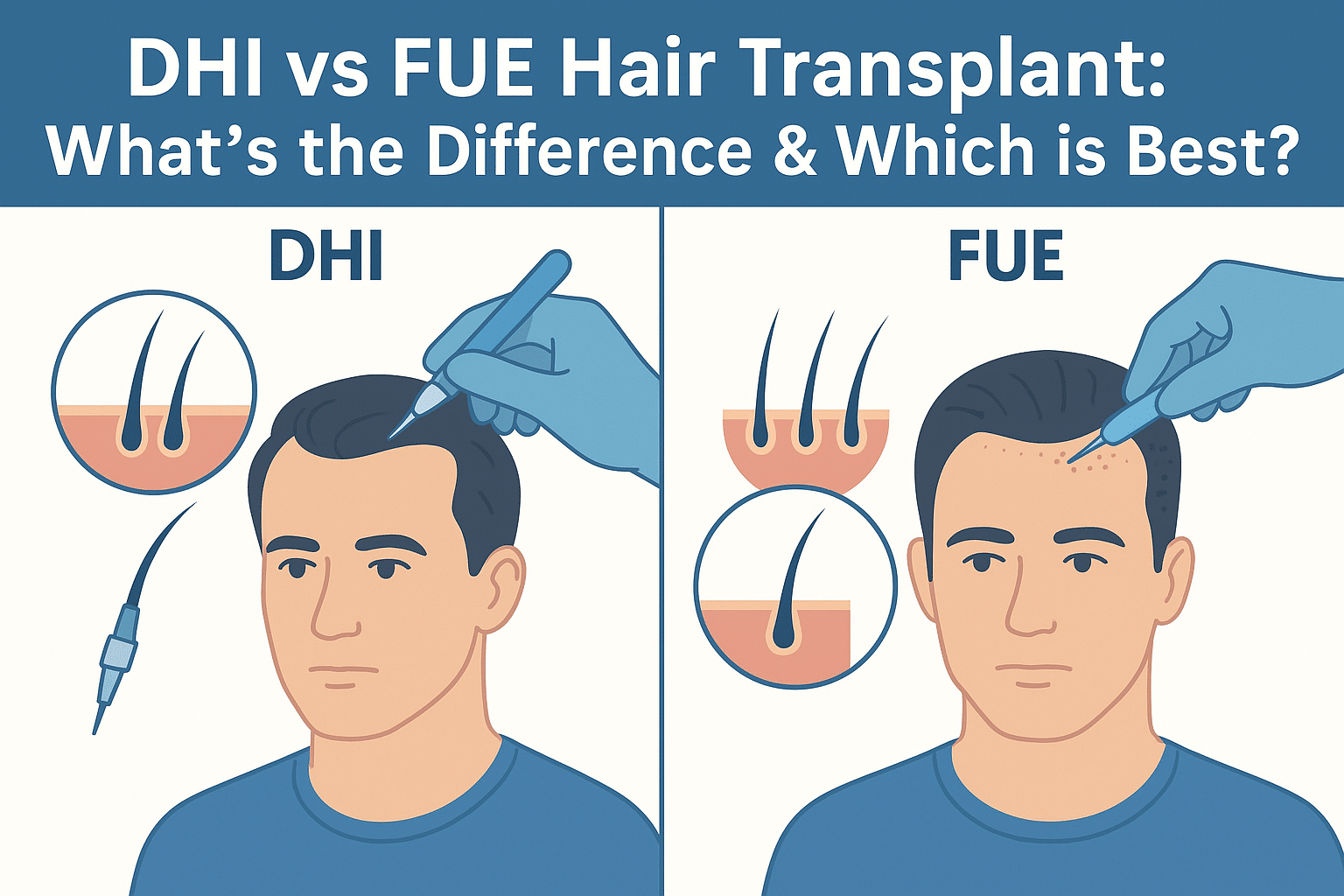
Before comparing, it’s important to understand the foundation.
All modern methods share a common principle:
Healthy hair follicles are harvested from the donor area (usually the back and sides of the scalp) and transplanted into thinning or balding regions.
The differences lie in:
How grafts are extracted
How recipient sites are created
How follicles are implanted
The tools used during surgery
FUE follicular unit extraction is currently the most widely used method globally.
In this technique:
Individual hair follicles are extracted from the donor area using micro punches.
Tiny incisions are created in the recipient region.
Grafts are placed into these channels.
Because grafts are extracted individually, FUE offers:
Minimal scarring
No linear scar
Shorter healing time compared to older strip methods
Flexible hair styling after recovery
This method replaced FUT (strip surgery) as the standard modern approach.
Traditional FUE uses steel micro-blades to create recipient channels.
Advantages:
Suitable for large areas
Reliable technique
Allows high graft numbers
Predictable outcomes
However, incision tools influence channel shape and tissue trauma.
Sapphire FUE is considered an advanced version of traditional FUE.
The difference lies in the tool used to create recipient channels.
Instead of steel blades, Sapphire FUE uses blades made from synthetic sapphire crystals.
These blades:
Are sharper
Create more precise incisions
Produce V-shaped channels
Cause less tissue trauma
Benefits often associated with sapphire fue include:
Denser packing
Reduced trauma
Faster recovery times
Improved healing time
Extraction remains FUE — the implantation method changes slightly due to blade precision.
DHI direct hair implantation is a variation of FUE but differs in implantation technique.
In DHI:
Follicles are extracted using FUE.
Instead of creating channels first, grafts are implanted directly using a Choi implanter pen.
The device allows surgeons to extract and implant in one continuous workflow.
This eliminates the separate channel-creation step.
DHI allows:
Precise angle control
High-density implantation
No pre-made incisions
Reduced graft handling time
|
Feature |
Traditional FUE |
Sapphire FUE |
DHI |
|---|---|---|---|
|
Extraction |
FUE |
FUE |
FUE |
|
Channel Creation |
Steel blade |
Sapphire blade |
No pre-channels |
|
Implantation |
Forceps |
Forceps |
Choi implanter |
|
Density |
Moderate-high |
High |
Very high |
|
Large Areas |
Excellent |
Excellent |
Limited per session |
|
Healing Time |
Moderate |
Faster |
Slightly faster |
|
Cost |
Moderate |
Higher |
Highest |
For patients with advanced baldness covering large areas, traditional FUE or Sapphire FUE is often preferred.
Why?
DHI requires more time per graft
Implantation speed is slower
Mega sessions are more complex
FUE techniques allow:
Higher graft counts in a single session
Efficient coverage of crown and frontal region
Better workflow for extensive baldness
If covering large areas is the priority, FUE often has an advantage.
All three methods can produce natural looking results when performed correctly.
Density depends on:
Surgeon skill
Donor area quality
Channel angle and direction
Hair characteristics
DHI may offer slightly higher precision in:
Frontal hairline design
Temple reconstruction
Fine, detailed areas
Sapphire FUE may allow denser packing compared to traditional FUE due to smaller incisions.
Traditional FUE
Redness: 7–14 days
Scabs fall off: 10 days
Full healing: 2–3 weeks
Sapphire FUE
Slightly reduced trauma
Often faster recovery times
Reduced redness duration
Shorter healing time
DHI
No pre-made channels
Less tissue trauma
Similar or slightly shorter healing time
However, differences are often subtle and patient-dependent.
All three methods use FUE extraction, meaning:
No linear scar
Tiny dot scars
Minimal scarring
Donor area healing depends more on extraction skill than implantation method.
Regardless of technique:
Transplanted hair sheds in 2–4 weeks
Growth starts around month 3–4
Noticeable density by month 6
Final results at 12 months
Technique does not significantly alter biological hair growth cycles.
For patients seeking maximum graft coverage in a single session:
Traditional FUE and Sapphire FUE are more efficient
DHI may require longer operating time
Large sessions exceeding 4,000 grafts are more commonly done using FUE methods.
DHI generally costs more because:
It requires specialized implanter pens
Takes longer
Needs highly trained technicians
Sapphire FUE is priced higher than traditional FUE due to blade technology.
Traditional FUE remains the most cost-effective.
Natural hair appearance depends on:
Hairline artistry
Angle placement
Density planning
Surgeon expertise
No technique alone guarantees superior natural hair.
Surgeon skill matters more than the tool.
DHI may be ideal for:
Small to moderate baldness
High-density frontal zones
Patients wanting no shaving in some cases
Detailed hairline refinement
Sapphire FUE is often preferred for:
Dense packing
Reduced tissue trauma
Balanced approach between speed and precision
Modern advanced hair restoration
Traditional FUE remains strong for:
Covering large areas
High graft counts
Budget-conscious patients
Proven long-term reliability
Many clinics market Sapphire or DHI as superior.
However:
All are FUE-based
All rely on donor quality
All require skilled implantation
All depend on patient biology
Technology enhances precision, but does not replace expertise.
Antalya has become a global hub for advanced hair restoration, including DHI procedures.
Clinics offering DHI Hair Transplant in Antalya often focus on:
High-density implantation
Modern equipment
Experienced surgical teams
International patient care
The region combines medical expertise with tourism advantages.
Similarly, Sapphire FUE Hair Transplant in Antalya has gained popularity due to:
Advanced sapphire blade technology
Competitive pricing
Skilled FUE specialists
High patient volume experience
Patients travel globally for these procedures due to cost-quality balance.
There is no universal “best” technique.
The ideal method depends on:
Baldness stage
Donor area quality
Desired density
Budget
Surgeon experience
If covering large areas, FUE or Sapphire FUE may be better.
If focusing on precision and hairline refinement, DHI may be advantageous.
Ultimately, a well-performed procedure using any of these methods can achieve natural looking results, restore confidence, and support long-term hair growth.
The most important factor is not the tool — but the surgeon behind it.
Advanced Surgical Comparison: DHI vs FUE vs Sapphire FUE
Now let’s go deeper into the technical and surgical aspects that truly determine outcomes — beyond marketing language.
When comparing DHI direct hair implantation, FUE follicular unit extraction, and Sapphire FUE, the real differences lie in:
Channel creation method
Implantation workflow
Surgical speed
Graft handling time
Tissue trauma
Strategic suitability for large areas
All three methods rely on extracting grafts from the donor area using FUE principles. However, what happens next differs.
Traditional FUE
Extract grafts
Create recipient sites
Implant grafts
This three-step workflow allows surgeons to control:
Density
Direction
Angle
Hairline design
The separation between channel opening and implantation offers flexibility in treating large areas in a single session.
Sapphire FUE follows the same structure as traditional FUE but uses sapphire blades for channel creation.
Because sapphire blades are sharper and thinner:
Incisions are more precise
Tissue trauma may be reduced
Channels can be placed closer together
Healing time may be slightly shorter
However, it is still fundamentally FUE — simply an advanced version of the same technique.
DHI changes the workflow significantly.
Instead of creating channels first, the surgeon:
Loads grafts into an implanter pen
Inserts each graft directly into the scalp
Controls depth and angle in real time
This “extract and implant” method eliminates the pre-made channel phase.
The theoretical benefits:
Reduced graft dehydration
Precise angle control
Potentially lower trauma
High-density placement in specific zones
However, it is more time-intensive and less efficient for large areas.
Many patients believe DHI automatically creates better natural looking results.
This is not entirely accurate.
Natural results depend on:
Hairline artistry
Correct angulation
Strategic placement of single-hair grafts
Preservation of existing natural hair
Donor quality
All three techniques can produce excellent outcomes when performed correctly.
The key difference lies in how densely grafts can be packed safely.
For Large Bald Areas (Norwood 5–6)
Best options:
Traditional FUE
Sapphire FUE
These methods allow:
4000–5000+ grafts
Efficient coverage
Better workflow efficiency
Shorter total operation time
DHI can technically treat large areas, but it significantly increases surgical time.
DHI can be advantageous when:
Rebuilding temple angles
Refining hairline density
Avoiding shaving in select cases
Working between existing hairs
The Choi pen allows precise placement between native follicles.
Traditional FUE
7–10 days scabbing
10–14 days redness
2–3 weeks surface healing
Standard recovery time
Sapphire FUE
Because of smaller incisions:
Slightly improved healing time
Reduced swelling in some cases
Potential faster recovery times
DHI
Minimal channel trauma
Comparable recovery
Slightly reduced inflammation in some patients
However, differences in recovery are generally moderate — not dramatic.
All FUE-based techniques:
Avoid linear scars
Produce micro-dot scarring
Allow short hairstyles
The real risk to the donor area is overharvesting — not technique choice.
Proper donor management determines long-term success.
When treating advanced baldness, many patients prefer maximum graft extraction in a single session.
Traditional FUE and Sapphire FUE are more efficient in mega-sessions because:
Channel creation is faster
Implantation can be team-based
Workflow allows higher graft throughput
DHI is typically slower per graft due to pen loading.
Regardless of technique:
2–4 weeks: shedding phase
3–4 months: early hair growth begins
6 months: visible density improvement
12 months: final result
Technique does not significantly alter biological growth cycles.
Potential risks across all techniques:
Shock loss
Infection (rare)
Overharvesting
Poor angulation
Low graft survival if poorly handled
No technique eliminates risk completely.
Skill and experience matter more than device branding.
DHI is ideal for:
Small to moderate hair loss
High-density frontal design
Refinement procedures
Patients wanting minimal shaving
Precision-focused hairline work
Sapphire FUE may be ideal for:
Balanced density and speed
Dense packing
Moderate to large areas
Patients wanting advanced blade technology
Traditional FUE remains effective for:
Large bald areas
High graft counts
Cost-conscious patients
Proven, predictable outcomes
Many clinics promote one technique as “the best.”
In reality:
There is no universal best technique.
The best approach depends on:
Baldness stage
Donor capacity
Hair characteristics
Budget
Long-term planning
Surgeon expertise
Hair loss is progressive.
An advanced hair plan should include:
Donor preservation
Future session planning
Realistic density goals
Natural aging design
Medical therapy when appropriate
Choosing a technique without a long-term strategy is a mistake.
So, which is best: DHI vs FUE vs Sapphire FUE?
✔ For large areas → FUE or Sapphire FUE
✔ For precision hairline work → DHI
✔ For balanced approach → Sapphire FUE
✔ For cost efficiency → Traditional FUE
All three can produce excellent, natural looking results when performed by an experienced surgeon.
The technique is a tool.
The surgeon determines the outcome.


