




If the eyes are the mirror of the heart, then the eyebrows are the frame of that mirror. Eyebrows are the fundamental element that conveys a face's expression—whether angry, surprised, tired, or dynamic. You can regain the expression you have lost due to years of incorrect plucking, the artificiality created by permanent makeup, or genetic hair loss with the art of "Micro-DHI Eyebrow Transplantation" at Haarex Clinic.
Not Just Hair, But a Matter of "Character"
Although eyebrow transplantation is technically similar to hair transplantation, it is one of the most challenging procedures in the world in terms of logic and aesthetics. You can cover up a mistake in your hair by combing it, but there is zero margin for error with the eyebrows right in the middle of your face.
At Haarex Clinic in Antalya, our approach to eyebrow transplantation is more "architectural" than medical. Because eyebrows:
- Ensure facial symmetry.
- Add depth and meaning to the eyes.
- Can make a person appear younger or older than they are (raised eyebrows indicate youth, while low eyebrows indicate fatigue).
"Do Eyebrows Stop Growing?" The Truth
What is commonly known as "eyebrow loss" is a medical reality. Eyebrows are the most
sensitive roots in the body. Repeatedly plucking from the same spot causes trauma to the
root and prevents it from growing back. When stress, thyroid disorders, and aging are added
to the mix, eyebrows thin irreversibly. At this point, eyebrow transplantation in Antalya is
the only permanent solution.
Eyebrow Transplantation or Microblading (Tattooing)?
Many women (and men) opt for microblading or eyebrow contouring because they think it's practical. However, these methods are two-dimensional and look artificial when viewed up close. Eyebrow transplantation, on the other hand, is a three-dimensional, natural, and real solution
| Feature | Eyebrow Transplantation (Haarex Method) | Permanent Makeup / Microblading |
|---|---|---|
Appearance |
3D, Voluminous and Real Hair. | 2D, Flat and Painted Look. |
| Durability | Lifetime (Does not fall out). | Should be renewed every 1-2 years (Color fades, reddens). |
| Naturalness | 100% Natural. Moves in the wind. | Looks like paint when viewed up close. |
| Tissue Damage | None. | Repeated procedures may leave scars on the skin. |
Eyebrow Transplant Engineering: 3 Different Directions, 3 Different Angles
Hair usually grows in a single direction. However, eyebrows change direction like a fan as they progress from the center of the face towards the temples. Haarex Clinic specialists plan by dividing the eyebrow into 3 areas:
1. Head Section
This is the section near the root of the nose. Here, the hairs grow almost vertically upward (close to 90 degrees). If the hair is planted at an angle here, the eyebrows will appear to meet in the middle, which looks unnatural.
2. Body Section
This is the middle section where the eyebrow is densest. Here, the hairs gradually flatten out and begin to turn toward the temple (45 degrees). The "spine" line, where hairs coming from two different directions intersect, is formed here.
3. Tail Section
This is the outermost end of the eyebrow. Here, the hairs are almost flush with the skin (0-5 degrees). The slightest angle error here will cause the eyebrow to stick out. Correctly attaching the tail section is proof of the surgeon's skill.
Eyebrow Transplant Technique Selection: DHI and Sapphire FUE Compatibility
Eyebrow transplantation is a micro-surgical procedure requiring millimeter precision. At Haarex Clinic, eyebrow transplant operations are performed using either the Sapphire FUE or DHI techniques, depending on the patient's eyebrow structure and the required density. Our goal is not to impose a technique, but to achieve the most aesthetic result.
The Role of Techniques in Eyebrow Transplantation:
- Shaping with Sapphire FUE: If there are no eyebrows or transplantation is to be performed on a very large area, the smoothness and fine structure of sapphire tips provide an excellent foundation for creating the desired curve and density. It ensures the natural inclination of the eyebrow (parallel to the skin) without leaving any traces.
- DHI for Thickening: If existing eyebrows need to be filled in or scar tissue such as stitch marks needs to be covered, the pinpoint accuracy of DHI pens is preferred.
What Matters is Manual Dexterity: The tool used in eyebrow transplantation (pen or
sapphire) is a means to an end; what really matters is the direction and angle the surgeon
gives using that tool. Our specialists transplant your eyebrows at a narrow angle to the skin
using both techniques so that they do not grow straight up.
The Secret of the Donor Area: Selecting the "Finest"
In hair transplantation, we look for the thickest, most multiple (3-fold, 4-fold) grafts so that it looks full. In eyebrow transplantation, it's the exact opposite!
The hair on the back of the neck is naturally thicker than eyebrow hair. If you transplant thick strands from the back of the neck to the eyebrows, the result will be a coarse and stiff appearance.
Haarex Protocol: Our specialists select the finest, most delicate, and strictly SINGLE grafts from the lower part of the back of the head, the area near the neck, or behind the ears. Selection is performed under a microscope. This "fine workmanship" is essential for a natural eyebrow appearance.
Eyebrow Design: Finding the Most Suitable "Arch" for Your Face
The ideal eyebrow shape differs for each person. Curved eyebrows suit round faces, while straight eyebrows suit long faces. We use the "Golden Ratio Compass" during the design process:
- Starting Point: An imaginary line drawn upward from the wing of the nose.
- Curve (Apex) Point: The highest point where the line drawn from the wing of the nose to the center of the pupil intersects with the eyebrow. This is the point that lifts the eyebrow and rejuvenates the gaze.
- End Point: A line drawn from the wing of the nose to the outer edge of the eye. The eyebrow should end here; if it is shorter, the face appears wider, and if it is longer, the eye appears lower.
Patient Approval: After the drawing is done, you examine yourself in the mirror. We check
your facial expressions. We do not begin the procedure until you say, "Yes, this is my
eyebrow."
Surgery Day: Big Change in a Short Time
Compared to hair transplantation, eyebrow transplantation is a much shorter and comfortable "lunchtime procedure." At Haarex Clinic, the process works as follows:
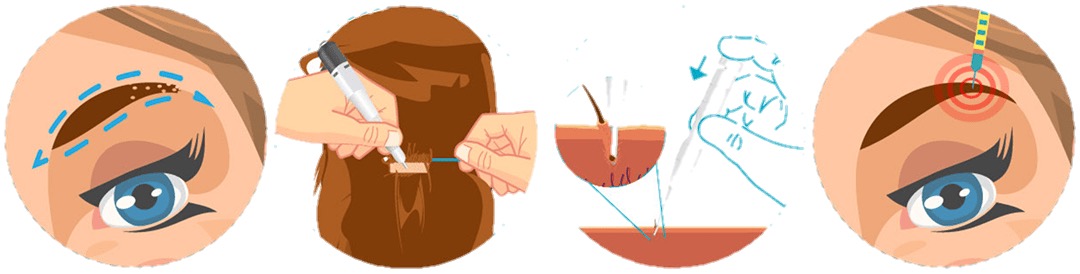
1. Local Anesthesia
Local anesthesia is applied only to the eyebrow area and the donor area at the back of the head (in the shape of a small window). You will be fully awake. You will not feel any pain or discomfort.
2. Graft Harvesting (Micro-Window)
Female patients do not need to have their hair shaved. Between 300 and 600 fine-haired grafts are collected one by one using a micro-motor from an inconspicuous area at the back of the neck.
3. Transplantation (DHI Sensitivity)
Your doctor implants the roots placed in the Choi pen, adhering to the previously drawn boundaries. At this stage, you are seated in a comfortable position and provided with a mirror for checking. Symmetry is confirmed immediately.
Important Information: Do Transplanted Eyebrows Grow?
The most important biological fact that everyone considering eyebrow transplantation should know is this: Since hair follicles are used as the donor, transplanted eyebrows behave like hair and continue to grow.
Eyebrow Care and Maintenance
During the first year after the procedure, you will notice that your transplanted eyebrows
grow as quickly as your natural hair. This is not a problem; it is simply part of the process.
What you need to do:
- Weekly Trimming: You should trim the growing ends 1-2 times a week with small eyebrow scissors.
- Gel/Fixative Use: It is beneficial to guide (train) the newly growing hairs with transparent eyebrow gels during the first few months so that they grow flat.
- Adaptation Process: A phenomenon called "metaplasia" occurs, as described in medical literature. Over time (within 2-3 years), the hairs adapt to the blood flow rate of the transplanted area (the eyebrow) and their growth rate slows down. However, minimal maintenance may still be required for life.
Recovery Process: When Can I Return to Social Life?
Recovery after eyebrow transplantation is extremely fast. Since it is in the center of the face, it may attract attention for the first few days, but this process can be managed with the right camouflage.
| Time | Expected Condition | Recommendations |
|---|---|---|
| First 3 Days | Mild swelling (may extend to the eyelid) and redness. | Apply ice. Do not lie face down. Avoid contact with water. |
| Days 4-5 | Scabbing begins. Small blood clots dry out. | Gently soften with the provided moisturizing lotion. |
| Day 8 | Scabs fall off completely. | Your eyebrows are now visible. Redness fades to a light pink. |
| Week 2 | Shock Loss phase. | The transplanted eyebrows fall out. Don't worry, the roots are still inside. |
| Month 3 | Growth begins. | Fine and weak hairs appear. |
| Months 6–8 | Final Result. | You will have full, shaped, and permanent eyebrows. |
Scar and Old Permanent Makeup Transplantation
One of the most common requests at Haarex Clinic is "Scar Transplantation."
Scar/Burn Scar: Can hair be transplanted onto scar tissue where hair follicles have died? Yes. Using the DHI technique, successful hair transplantation can be performed even on scar tissue with poor blood circulation, completely concealing the scar.
Transplantation Over Permanent Makeup: You previously had eyebrow contouring done, but the color has faded or you are unhappy with the shape. Instead of going through the trouble of laser removal, transplantation can be performed directly over the dye. This allows the dye to remain underneath like a shadow, making the eyebrows appear fuller.
What Determines Eyebrow Transplant Prices in Antalya?
Eyebrow transplant prices are determined based on the "Difficulty Level of the Operation," not the number of grafts. This is because a 300-graft eyebrow transplant requires as much effort and expertise as a 3000-graft hair transplant due to the artistic attention it requires. Haarex Clinic uses a package pricing system and does not impose any surprise costs.
Frequently Asked Questions About Eyebrow Transplantation
When can I apply makeup after eyebrow transplantation?
To prevent the risk of infection, foundation, eyebrow pencil, or eyeshadow should not be applied to the transplanted area for the first 10 days (until the scabs fall off). After the 10th day, makeup can be applied in a way that does not prevent the skin from breathing.
Can you create the eyebrow shape I want (Audrey Hepburn, thick, straight, etc.)?
Theoretically, yes, but in practice, eyebrows that don't match your facial anatomy will look unnatural. Our doctor will recommend the design that best suits you by striking a balance between your desired style and your face's golden ratio. The final decision is yours.
Can I pluck my eyebrows?
You can pluck any stray hairs that grow outside the transplanted eyebrows with tweezers. However, you should not pluck the transplanted roots themselves with tweezers, as this could damage the root. Trimming with scissors is recommended.
Will transplanted eyebrows fall out?
No. Transplanted roots are taken from the nape of the neck, which has a non-shedding genetic makeup, so they are permanent for life. You will not lose your eyebrows except in extreme circumstances such as stress or illness.
Your Looks are Your Signature.
Forget the tired look, the hassle of tinting your eyebrows every morning, and those fading tattoos. Get natural, permanent eyebrows that add definition to your face with Haarex Clinic's micro-art touch.
Are you wondering if your dream eyebrow style will suit your face?
💖 Send a Photo via WhatsApp, Let's Design