

When it comes to celebrity hair transplants, few transformations have generated as much discussion as that of Machine Gun Kelly—better known as MGK. Fans who have followed his career since the early 2010s quickly noticed a dramatic change in mgk’s hair, especially when comparing older photos with his recent appearances.
So the question is unavoidable:
Did MGK really have a hair transplant—and if so, what kind?
In this in-depth analysis, we break down MGK’s hair journey from 2013 MGK era to today, examine signs of hair loss, review before–after visuals, and provide expert insights into what likely happened from a clinical perspective.
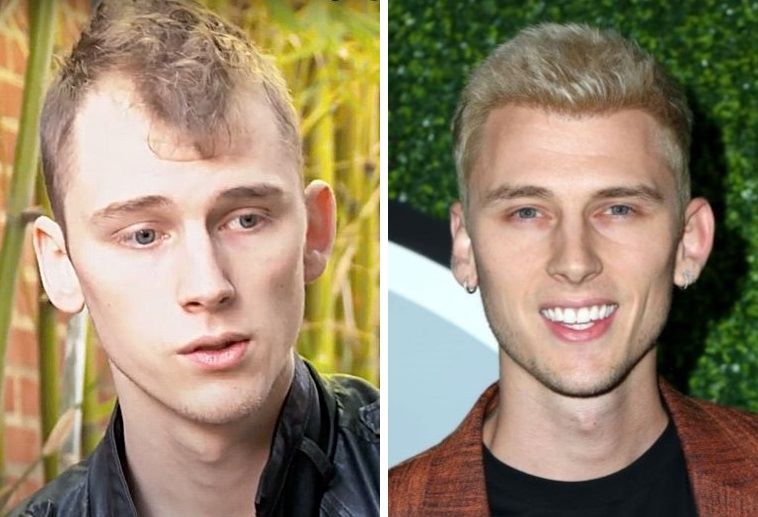
Around 2013, MGK’s look was raw, edgy, and minimalist. His hairstyle often exposed his hairline, making changes easy to track.
During this period, observers noted:
A visibly receding hairline at the temples
Uneven frontal density
Early signs of thinning hair in the frontal third
This pattern is typical of early male pattern baldness, especially in men with strong temple recession.
Between 2013 and the late 2010s, MGK’s hair showed:
Progressive temple recession
Reduced coverage in the frontal thinning area
Less consistent hair growth along the hairline
At this stage, styling alone could no longer fully mask the changes. This is usually the point where patients begin considering hair restoration options.
In more recent years, fans noticed something striking:
A fuller, more balanced frontal hairline
Improved density at the temples
A smoother, more youthful frame to the face
This shift was too structured and consistent to be explained by styling or products alone—leading to widespread belief in a machine gun kelly hair transplant.
Before
Clear temple recession
Irregular hairline
Visible thinning at the front
After
Reinforced frontal edge
Natural but denser temples
Balanced transition from hairline to mid-scalp
This type of improvement is strongly associated with a hairline transplant, not non-surgical treatments.
Based on visual evidence and current best practices for celebrities, experts widely believe MGK underwent follicular unit extraction (FUE).
Why FUE Makes Sense
No linear scar
Ideal for public figures
Allows precise frontal reconstruction
Supports natural-looking density
An alternative, follicular unit transplantation (FUT), would likely leave a visible scar—something not observed in MGK’s case.
One of the strongest indicators of surgery is design.
MGK’s current hairline shows:
Micro-irregularities (not a straight line)
Age-appropriate positioning
Gradual density increase from front to back
This level of control is a hallmark of a professionally executed hairline transplant.
In successful FUE procedures:
The donor area retains natural density
No patchiness is visible
Hair can be worn short
MGK has appeared with short and styled haircuts without visible donor damage—supporting the FUE theory.
Non-surgical methods (PRP, medication) can:
Improve hair quality
Slow hair loss
Slightly thicken existing hair
However, they cannot rebuild a receded hairline.
MGK’s transformation involved new frontal density, which points strongly toward surgical intervention rather than maintenance alone.
After a transplant:
Transplanted hairs shed in the first weeks
Regrowth begins around 3–4 months
Visible density appears by 6–9 months
MGK’s public timeline aligns closely with this pattern, reinforcing the conclusion of a kelly’s hair transplant.
Several factors contributed to success:
Conservative graft numbers
Respect for facial proportions
Proper angle and direction of implantation
Strong donor hair quality
The result blends seamlessly with existing hair—one reason his case is often cited in discussions of celebrity hair transplants done right.
MGK appears to have acted before advanced male pattern baldness developed. Early intervention typically leads to:
Better density
Fewer grafts needed
More natural long-term results
Waiting longer often complicates outcomes.
Currently, gun kelly’s hair shows:
Stable hairline
Uniform density
No visible progression of recession
This stability is exactly what surgeons aim for with a well-planned transplant.
Among celebrity examples, MGK stands out because:
The before/after difference is clear
The result isn’t overdone
The hairline suits his age and style
It’s a practical illustration of how hair restoration can enhance appearance without erasing character.
MGK’s journey highlights important takeaways:
Early hair loss can be corrected effectively
Hairline design matters more than graft count
Natural results come from restraint and planning
Not every transplant needs to aim for teenage density.
For musicians and actors, image consistency is critical. A subtle, natural transplant allows:
Continuity across appearances
Freedom in styling
Confidence on and off stage
MGK’s case shows how surgical intervention can support—not replace—personal style.
Based on:
Clear before/after differences
Rebuilt frontal hairline
FUE-consistent donor appearance
Natural, lasting density
👉 Yes—MGK almost certainly underwent a hair transplant, most likely using follicular unit extraction.
His transformation represents a textbook example of a modern, well-executed hairline transplant.
MGK’s hair journey proves that hair transplants don’t have to look artificial or extreme. When done early, conservatively, and by experienced hands, the results can be subtle yet powerful.
For many men dealing with thinning hair or a receding hairline, MGK’s case offers a realistic and encouraging example of what’s possible with today’s techniques.


