

Hair loss affects millions of men worldwide, and for many, it follows a predictable pattern. One of the most widely recognized tools used to classify this progression is the Norwood scale, also known as the Norwood-Hamilton scale. This system helps physicians, surgeons, and patients understand the stages of hair loss, especially those associated with male pattern baldness.
If you are noticing a receding hairline, thinning at the top of the head, or a developing bald area, understanding where you fall on the Norwood-Hamilton classification can help guide treatment decisions — including whether a hair transplant is appropriate.
In this comprehensive guide, we will explore:
What the Norwood-Hamilton scale is
The history behind the Hamilton scale
Each stage in detail
What happens to hair follicles at every level
How androgenetic alopecia progresses
Treatment strategies by stage
When hair restoration becomes necessary
Differences between the Norwood and Ludwig scale
Let’s break down this essential framework in hair loss diagnosis.
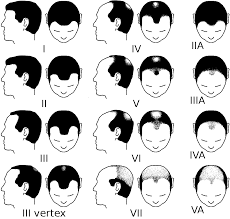
The Norwood-Hamilton scale is one of the most widely used classification systems for male pattern baldness. It categorizes the progression of androgenetic alopecia into distinct stages based on visible patterns of hair thinning and recession.
Originally introduced as the Hamilton scale in the 1950s, it was later refined by Dr. O’Tar Norwood in the 1970s. The updated version — commonly called the Norwood scale — remains the global standard for assessing the stages of male pattern baldness.
This scale ranges from minimal hairline changes to advanced stages featuring extensive baldness with a horseshoe shaped pattern around the sides of the head.
Understanding your stage on the Norwood scale is important because:
It predicts future progression
It guides hair transplant planning
It helps determine treatment timing
It sets realistic expectations
It supports long-term hair restoration strategy
Hair loss is progressive, and early intervention can preserve more hair follicles.
The most common cause of hair loss in men is androgenetic alopecia.
This condition is driven by:
Genetic predisposition
Sensitivity of hair follicles to DHT
Hormonal influence
Aging
In androgenetic alopecia:
The hairline recedes
The crown begins thinning
The frontal hairline changes shape
Eventually, a bald area develops
However, the sides of the head and back usually remain intact due to DHT resistance.
Let’s examine each stage in detail.
Norwood Stage 1
No visible hair loss
Juvenile hairline
No recession
At this stage, the hairline remains intact, and there are no signs of thinning.
Norwood Stage 2
Mild temple recession
Early receding hairline
Slight triangular thinning
The hairline recedes slightly at the temples, forming a subtle “M” shape.
Hair density remains strong overall.
Norwood Stage 3
This is considered the first clinically significant stage of baldness.
Noticeable frontal recession
Deep temple loss
Clear M-shaped hairline
At this stage, many men begin seeking hair restoration options.
Norwood Stage 3 Vertex
In this variation:
Frontal hairline may remain stable
A small bald area appears at the crown (vertex)
Thinning occurs at the top of the head
This crown-focused thinning can expand over time.
Norwood Stage 4
Larger crown bald area
More pronounced frontal recession
Separation between front and crown
The bald area at the crown becomes more visible.
There is still a bridge of hair separating front and back.
Norwood Stage 5
Bridge between crown and front becomes thinner
Larger bald area
Significant hair loss
At this stage, the remaining hair begins to form a pattern that will eventually become horseshoe shaped.
Norwood Stage 6
Frontal and crown areas merge
No hair remains on the top of the head
Only hair on the sides of the head remains
The horseshoe pattern becomes dominant.
This represents advanced stages of male pattern baldness.
Norwood Stage 7
Only a narrow band of hair remains
Extensive baldness
Fully horseshoe shaped pattern
Hair follicles in the top region are mostly miniaturized beyond recovery.
As baldness progresses:
Hair follicles shrink
Growth cycles shorten
Hair becomes thinner
Terminal hairs turn into miniaturized hairs
Eventually, follicles stop producing visible hair
In early stages of hair loss, follicles are still alive and may respond to medical therapy.
In later stages, surgical intervention such as hair transplant may be necessary.
The Norwood scale plays a critical role in transplant planning.
Early Stages (Norwood 2–3)
Preventive treatment recommended
Medication may slow progression
Small frontal transplant possible
Mid Stages (Norwood 4–5)
Moderate graft requirement
Crown and frontal restoration needed
Donor management becomes crucial
Advanced Stages (Norwood 6–7)
Large graft numbers required
Strategic density distribution
Long-term planning essential
A successful hair transplant depends on realistic graft allocation and donor preservation.
Before Norwood expanded the classification, Dr. James Hamilton introduced the original Hamilton scale.
It described progressive baldness patterns based on age-related androgen sensitivity.
Norwood later refined and expanded this scale to create the modern Norwood-Hamilton system.
While the Norwood scale applies to men, the Ludwig scale is used for female hair loss.
Differences include:
Women rarely develop a horseshoe shaped pattern
Female thinning is usually diffuse
Frontal hairline often remains intact
The Ludwig scale focuses on crown density rather than temple recession.
Yes.
Some men stabilize at Norwood 2 or 3 and do not progress to severe baldness.
Others continue progressing into advanced stages.
Genetics largely determine progression speed.
Early signs include:
Hairline recedes noticeably
Increased shedding
Thinning at the top of the head
Family history of baldness
Early treatment options may include:
Minoxidil
Finasteride
PRP therapy
Lifestyle modifications
Intervening before significant hair loss improves outcomes.
Hair loss can impact:
Self-confidence
Social interaction
Professional perception
Understanding your stage helps reduce uncertainty and provides clarity.
The Norwood-Hamilton scale classifies stages of male pattern baldness.
It ranges from minimal progressive recession to extensive horseshoe shaped patterns.
It helps guide hair transplant and medical treatment decisions.
Early intervention preserves hair follicles.
Advanced stages require strategic hair restoration planning.
The Ludwig scale is used for female pattern hair loss.
The Norwood scale remains the gold standard among classification systems for evaluating male pattern baldness.
By understanding where you fall within the stages of hair loss, you can make informed decisions about prevention, treatment, and long-term hair restoration.
Hair loss is progressive — but with the right strategy, you can manage it effectively.
If you’re unsure about your stage, a professional consultation with a qualified specialist is the best next step.


