

Hair restoration has evolved dramatically over the past two decades. Among the most talked-about innovations is the robotic hair transplant system, which uses artificial intelligence and precision robotics to assist surgeons during the extraction phase of the hair transplant procedure.
But is robotic hair restoration truly superior? How does it compare with traditional follicular unit extraction? What are the benefits, risks, and cost in 2026?
In this comprehensive 4000-word guide, we break down everything you need to know.
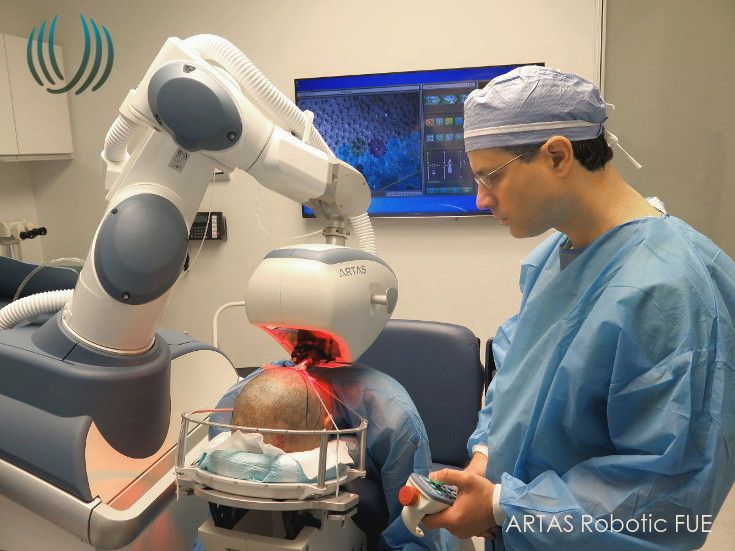
A robotic hair transplant is a type of hair transplant surgery that uses a computerized robotic arm to assist in harvesting hair follicles from the donor area.
The most well-known platform is the ARTAS robotic hair transplant, developed by Restoration Robotics.
Unlike fully manual procedures, the robotic system:
Uses high-resolution imaging
Maps individual follicular units
Selects optimal grafts
Extracts follicles using a precision-guided robotic arm
The implantation phase may still be performed manually by a surgeon.
The robotic hair transplant system combines:
Digital imaging
Artificial intelligence
Machine learning
Mechanical precision
Step-by-step process:
Step 1: Digital Mapping
The system scans the scalp and identifies:
Density in the donor area
Angle of hair growth
Distribution of follicular units
Thickness and type of hair
Step 2: AI-Based Selection
The software selects the healthiest grafts for extraction.
Step 3: Extraction with Robotic Arm
The robotic arm removes individual grafts using a punch tool, similar to the FUE method.
Step 4: Implantation
The surgeon implants grafts into thinning areas manually.
Most robotic systems are essentially advanced forms of follicular unit extraction.
Traditional FUE:
Surgeon manually extracts grafts.
Requires high technical skill.
Operator-dependent precision.
Robotic Hair Restoration:
AI-assisted graft selection.
Automated extraction.
Reduced human fatigue.
Highly standardized process.
Both are considered minimally invasive procedures.
Yes.
The ARTAS robotic hair transplant received FDA approval for assisting in follicular extraction.
However:
FDA approval applies to the device.
The overall surgical outcome still depends on the surgeon’s expertise.
FDA approval does not mean it is superior in all cases — only that it meets safety and performance standards.
✔ Precision
The robotic system can calculate:
Hair angle
Depth
Spacing
Follicle orientation
This increases accuracy during extraction.
✔ Reduced Human Error
Because the system analyzes thousands of grafts per hour:
Fatigue-related inconsistencies decrease.
Overharvesting risk may reduce.
✔ No Linear Scar
Like the FUE method, robotic extraction does not leave a linear scar, unlike older strip (FUT) procedures.
✔ Consistency in Large Sessions
Robotics can maintain stable extraction quality even during long procedures.
✔ Advanced Technology Integration
The integration of advanced technology improves:
Graft selection
Density planning
Scalp mapping
Despite innovation, robotic systems are not perfect.
❌ Limited to Straight Hair Types
Curly hair types may be more challenging for some robotic systems.
The type of hair influences extraction accuracy.
❌ Still Surgeon Dependent
The robot does not perform the entire hair transplant surgery.
Implantation still depends on:
Surgeon artistry
Hairline design
Density planning
❌ Potential Overharvesting
If not carefully supervised, repeated robotic extraction may thin the donor area excessively.
❌ Higher Cost
Robotic procedures typically cost more due to equipment investment.
Ideal candidates include:
Early to moderate hair loss
Stable male pattern baldness
Strong donor area density
Straight or mildly wavy hair
Patients with advanced baldness may require combined techniques.
One common question is whether robotic systems save time compared to manual extraction.
Time Compared:
2000 graft manual FUE → 5–7 hours
2000 graft robotic extraction → 4–6 hours
Extraction may be faster, but total procedure time is often similar because implantation remains manual.
Robotic hair transplant recovery mirrors traditional FUE:
Day 1–3: Mild swelling
Day 7–10: Scabs fall off
Month 1: Shock shedding
Month 3–4: New growth
Month 12: Final results
Because it is minimally invasive, recovery is typically smooth.
Robotic hair transplant costs vary by country.
🇺🇸 United States:
$10,000 – $20,000+
🇬🇧 United Kingdom:
£8,000 – £18,000
🇹🇷 Turkey:
€3,000 – €6,000 (premium clinics)
For patients exploring Hair Transplant Antalya, robotic systems may be available in high-end clinics with competitive international pricing.
Cost depends on:
Number of follicular units
Clinic reputation
Surgeon expertise
Technology used
Not necessarily.
A robotic system enhances extraction precision, but final aesthetic outcome depends on:
Hairline design
Density placement
Graft survival
Surgeon experience
Robotics is a tool — not a replacement for medical skill.
Among modern hair transplant methods, the main options include:
FUT (Strip method) – leaves a linear scar
Manual FUE
DHI (Direct Hair Implantation)
Robotic-assisted FUE
Each has advantages depending on patient goals.
Yes — when grafts are taken from the permanent donor area, they are genetically resistant to DHT.
However:
Native hair may continue thinning.
Additional sessions may be required.
Restoration Robotics, the company behind ARTAS, pioneered AI-assisted extraction.
Their system:
Uses stereoscopic imaging
Identifies healthy follicles
Minimizes transection rates
But the operator still supervises the process.
Like all hair transplant surgery, risks include:
Infection
Overharvesting
Temporary shock loss
Follicle damage
Uneven density
Complications are rare when performed by experienced teams.
Robotic hair transplant offers:
✔ Technological precision
✔ Consistent graft extraction
✔ No linear scar
✔ FDA-approved device
But:
✖ Higher cost
✖ Still surgeon-dependent
✖ Not ideal for all hair types
It is best viewed as an advanced version of the FUE method, rather than a completely separate revolutionary technique.
The robotic hair transplant system represents a significant evolution in modern hair transplant procedure techniques.
Using AI-driven analysis and robotic precision, it enhances follicular unit extraction while remaining a minimally invasive solution for hair restoration.
However, technology alone does not guarantee perfection. The artistry of hairline design, proper graft handling, and strategic density planning remain human-driven.
In 2026, robotic hair restoration stands as a premium option for patients seeking cutting-edge solutions — but choosing the right surgeon remains more important than choosing the right machine.


